You ask an AI assistant: "Why did my store revenue fall last week?"
It replies that revenue decreased because customers bought fewer products. That sounds useful.
But did the AI actually examine your orders, customer behavior, product performance and inventory? Or did it generate a plausible ecommerce explanation because lower revenue is often associated with lower demand?
That difference is the most important thing to understand about commerce AI.
AI becomes genuinely useful in ecommerce analytics when it can work with the merchant's actual business data, understand the definitions and relationships behind that data, and show enough evidence for the merchant to verify its explanation.
Without that grounding, an AI assistant may still give good general advice. It just cannot reliably explain what happened inside your particular store.
What Does Commerce AI Mean in Ecommerce Analytics?
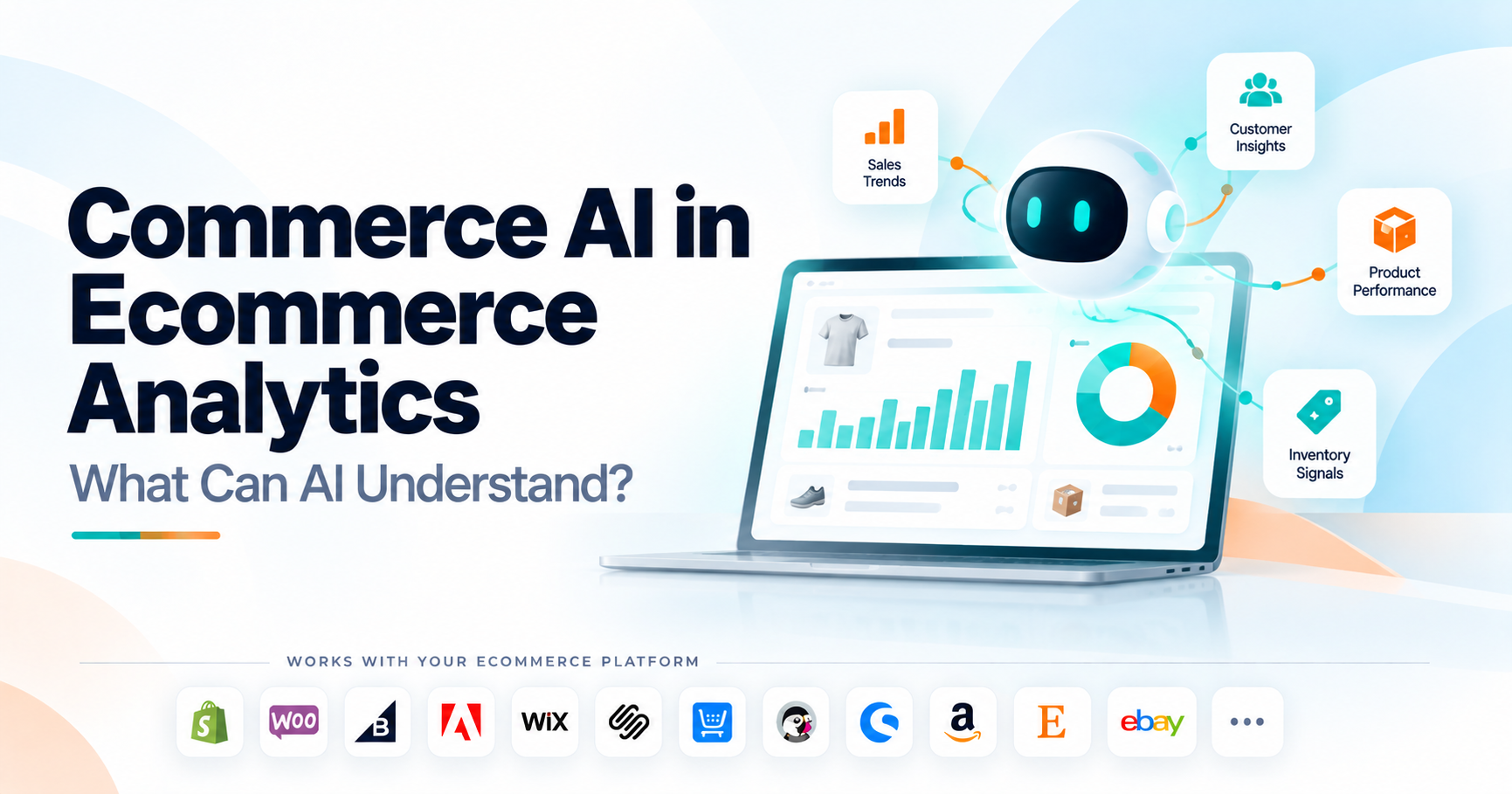
Commerce AI, in the context of analytics, means using artificial intelligence to help merchants explore, interpret and communicate information from ecommerce operations.
That can include sales, orders, customers, products, inventory, refunds, traffic, checkout activity and other available commerce data. It does not mean that AI somehow knows everything happening inside the business.
A useful commerce AI system can only work with the information it is allowed to access, the metrics it understands and the analytical tools available to it.
In practice, commerce AI may help a merchant ask questions in normal language, generate a report, compare periods, summarize an unusual change, identify relevant metrics or explain how different store signals relate.
Shopify provides a useful current example. Its Sidekick assistant can generate ShopifyQL queries, create data explorations, display visualizations and help merchants query areas such as sales, sessions, customers, payments, payouts, fulfillments and web performance.
The important part is that the assistant is working inside a commerce environment with access to defined store data.
That is very different from asking a general-purpose chatbot:
"Why are ecommerce sales declining?"
The general chatbot can discuss common reasons.
The connected commerce assistant can potentially investigate your own data.
Does Commerce AI Actually Understand Your Store?
Not in the same way a store owner or analyst understands the business.
AI can retrieve information, identify patterns, compare values, summarize relationships and reason over the context it receives. But its answer is limited by the available data and the way that data has been defined.
Suppose you ask: "Why did revenue fall?"
The AI may need access to: Revenue, Orders, Average order value, Customer activity, Product sales, Inventory availability, Discounts, Refunds & possibly traffic or conversion data.
If it can access only revenue, it can confirm that revenue declined.
It cannot reliably explain why.
If it can access revenue, orders and AOV, it can go one level deeper.
If orders remained stable but AOV decreased, the system can identify lower value per transaction as an important part of the change.
If product and inventory data are also available, the analysis can go further.
Maybe several high-value products were unavailable during the same period. The quality of the AI explanation therefore depends heavily on the quality, breadth and meaning of the connected data.
What Is the Difference Between Generic AI and AI Grounded in Store Data?
Generic AI provides answers based mainly on patterns learned during training and the information included in your prompt. Grounded AI adds relevant external or business-specific information to the context used for the answer.
Google Cloud describes grounding as connecting generative AI to data sources in order to improve factual accuracy and reduce the likelihood of hallucinations. Retrieval-augmented generation is one common grounding method.
For ecommerce, the difference is practical.
Ask generic AI: "Why might my average order value decline?"
It may correctly suggest smaller baskets, increased discounting, lower-priced products, customer-mix changes or inventory problems. Those are reasonable possibilities.
Ask an AI system grounded in your commerce data: "Why did my AOV decline last month?"
A useful response should examine what actually changed in your store.
It might find that customers bought roughly the same number of products per order, discounting barely changed, but lower-priced products represented a much larger share of sales because two premium products were unavailable.
That is no longer generic advice. It is data-supported investigation.
What Questions Can Commerce AI Answer Well?
Commerce AI works best when the question can be answered from clearly defined data the system can access.
A merchant might ask: "How did sales compare with last month?"
If the AI has access to consistent revenue data and comparable date ranges, that is a relatively straightforward question.
A more analytical question might be: "Which products contributed most to the revenue increase?"
Now the AI needs product-level sales for both periods and a way to calculate contribution to the change.
Another question might be: "Did new or returning customers drive growth?"
The system needs customer classification and revenue or order data connected to those customer groups. The complexity increases as the question crosses more areas of the business. The important principle is that the question must be answerable from the available evidence.
How Can AI Reason About Sales and Revenue?
AI can help make sales analysis faster by connecting headline results with their immediate drivers. Suppose monthly revenue decreases 12%.
A useful AI analysis should not stop at: "Revenue is down 12%."
It should investigate whether fewer orders, lower AOV, heavier discounts, more refunds or another measurable change contributed to the result.
If orders declined 2% while AOV fell 10%, the assistant can explain that lower spending per transaction appears to account for much more of the movement than order volume.
It can then help the merchant investigate the AOV change.
This is the same analytical principle explained in Ecommerce Analytics: How to Turn Store Data Into Decisions, but AI can reduce the amount of manual report switching required to follow the investigation.
The AI should help organize the evidence. It should not invent certainty.
How Can AI Help With Customer Analytics?
AI can make customer data easier to explore when customer definitions and transaction histories are available. A merchant might ask: "Are returning customers becoming less active?"
The system could compare returning-customer counts, orders or revenue across equivalent periods. The merchant could then ask: "Which customer group changed the most?"
This follow-up matters because natural-language analytics is not only about getting one answer. It is about being able to continue the investigation.
Shopify currently allows Sidekick to answer questions about customer data including new and returning customers, locations, order counts, RFM groups and predicted spend tiers, although some areas such as cohort projections have documented limitations.
That limitation is important. AI should know what it can answer and what it cannot. A confident response to an unsupported question is more dangerous than a clear statement that the required data is unavailable.
How Can AI Help With Product Performance?
AI can help merchants move beyond a simple bestseller ranking. Imagine Product A is still your highest-revenue product. That sounds positive.
But compared with last month, its sales fell 22%. Product B grew enough to hide that decline at store level.
An AI-assisted analysis could identify Product A as an important negative contributor even though it remains the number-one product by total revenue.
The merchant could then ask: "Did fewer units sell, or did the realized selling value change?"
That leads from a broad store result into a product-level explanation. The value comes from the sequence of questions. The first answer should make the next investigation easier.
How Can AI Use Inventory Data?
Inventory becomes much more useful when it is interpreted with product demand. An AI assistant that sees only "18 units remaining" cannot determine whether the situation is urgent.
Eighteen units may represent six months of supply for a slow-moving product. For a bestseller selling twelve units a day, it may represent less than two days of availability.
The AI therefore needs relevant context such as recent sales rate, available stock, incoming inventory or replenishment timing where those fields are available.
It can then surface an observation such as: "This product contributes heavily to revenue and current inventory is low relative to recent sales."
That is more useful than simply saying: "Stock is low."
The same principle applies throughout AI ecommerce analytics. A number becomes more meaningful when it is connected to the business context surrounding it.
Why Are Follow-Up Questions So Important?
Follow-up questions turn AI from a reporting shortcut into an analytical workflow. A normal dashboard may tell you: Revenue fell 8%.
An AI interaction could continue:
"Was the decline caused by fewer orders?"
"Which products lost the most revenue?"
"Were those products in stock?"
"Did returning customers buy less?"
"Were refunds unusually high?"
Each question narrows the investigation.
Shopify's current analytics experience demonstrates this broader shift toward conversational analysis. Merchants can ask Sidekick to generate or modify ShopifyQL reports using plain-language requests instead of constructing every query manually.
The real advantage is not simply that AI can produce a chart faster. It is that merchants can move from one business question to another without first translating every question into reporting syntax.
Why Do Plain-English Explanations Matter?
Most store owners do not need more technical analytics terminology. They need to understand what changed. Suppose the underlying data shows:
Revenue: down 9%
Orders: down 1%
AOV: down 8%
Premium Product A: down $7,400
Premium Product B: down $4,100
Both products had limited availability
A useful AI explanation might say: "Revenue declined mainly because average order value was lower while order volume remained relatively stable. Two higher-value products contributed most to the decline and both had limited availability during the period. Product availability deserves investigation before assuming overall demand weakened."
That is far easier to interpret than five disconnected charts. Notice the wording. It says inventory deserves investigation.
It does not claim: "Stockouts definitely caused the revenue decline."
That distinction is essential.
What Is an AI Hallucination in Ecommerce Analytics?
An AI hallucination, also called confabulation, occurs when an AI system generates information that is false, unsupported or inconsistent while presenting it as if it were reliable.
NIST defines confabulation in generative AI as confidently generated erroneous or false content, including output that can contradict the provided context. NIST also notes that this risk is a natural consequence of how generative models produce responses.
In ecommerce analytics, that could look like: "Your sales dropped because your Facebook campaign performed poorly."
But perhaps the AI never received advertising data. Or: "Returning customers declined because shipping prices increased."
But shipping-price history may not be available.
The explanation sounds commercially plausible.
That does not make it true.
This is why commerce AI should be judged not only by how natural the answer sounds, but by whether the answer is grounded in data the system actually has.
Does Grounding Completely Eliminate Hallucinations?
No. Grounding reduces the risk, but it does not make every AI answer automatically correct. Google Cloud explicitly describes grounding as a way to improve accuracy and reduce hallucinations, not as a guarantee that hallucinations disappear entirely.
Several problems can still produce a misleading answer.
The source data itself may be incomplete.
Metric definitions may differ.
A connector may not have synchronized recently.
Customer data may be unavailable on a marketplace.
Refunds may be recorded in a different period from the original sale.
The AI may interpret a correlation too strongly.
Reliable commerce AI therefore needs more than an LLM connected to an API.
It needs well-defined data, clear metric semantics, permissions, freshness information and ways for users to verify important conclusions.
Metric Definitions Matter More Than They Appear
Consider the word "revenue." One system may mean gross sales. Another may mean net sales after discounts and returns. Another may include shipping or tax.
If an AI assistant does not know which definition is being used, a perfectly fluent explanation can still be wrong.
The same problem exists with customers, refunds, conversion, inventory and marketplace metrics. Good AI store insights therefore depend on semantic context as well as raw values.
Google Cloud's current data-grounding documentation emphasizes this point by describing business semantics, glossaries, schemas, data lineage and verified context as important parts of grounding AI against enterprise data.
For ecommerce, that means AI needs to understand not just that a database column contains the number 84,320. It needs to understand what that number represents.
Can Commerce AI Determine Cause and Effect?
Not automatically. Commerce AI can identify relationships, timing and patterns that help narrow an investigation.
It cannot safely turn every correlation into a causal conclusion. Suppose:
Revenue declines.
A bestseller goes out of stock.
Returning-customer revenue also declines.
Those signals may be related.
But the data may not prove that the stockout caused the entire sales decline.
Maybe marketing traffic also weakened.
Perhaps another high-value product lost demand.
Maybe a promotion ended.
A good AI system should distinguish between: What the data directly shows and What the data suggests may deserve investigation
That makes the answer less dramatic but more trustworthy.
Where Is Human Judgment Still Required?
Human judgment is still required whenever the decision depends on business context that the AI does not fully possess.
An AI assistant may identify that a product is selling more slowly. The merchant may know that the product is being intentionally phased out.
AI may flag low inventory. The operations team may know that a large shipment arrives tomorrow.
AI may identify higher refunds. The business may know that a voluntary recall created a temporary increase.
AI may recommend investigating a declining customer segment. The merchant may know that the segment was intentionally excluded from a promotion.
The system sees data. The human often knows the strategy, operational constraints and exceptions behind that data.
The best use of AI is therefore not replacing business judgment. It is reducing the time required to collect and interpret the evidence needed for better judgment.
Should Merchants Trust Every AI-Generated Report?
No. Merchants should trust AI-generated reports only to the extent that they can understand the data source, metric definition and evidence supporting the result.
This becomes especially important when a report is used for inventory purchasing, pricing, marketing budgets or other decisions with financial consequences. A strong AI reporting for ecommerce workflow should make it possible to verify:
Which period was analyzed.
Which data source was used.
Which filters were applied.
How the metric is defined.
Whether the underlying data is current.
Which numbers support the explanation.
An attractive summary without traceability is not enough.
Our guide on Ecommerce Reporting vs Analytics explains why a report becomes more valuable when it creates a clear path into deeper investigation.
Commerce AI Should Respect Platform Differences
AI also needs to understand that ecommerce platforms and marketplaces do not expose identical information. A Shopify or WooCommerce store may provide detailed customer, product, inventory and website-performance data.
Amazon has marketplace-specific product, inventory and seller signals.
Etsy emphasizes visits, orders, revenue, conversion and listing performance.
eBay has its own sales, traffic, listing and seller-performance data.
Forcing every platform into the exact same analytical model creates false consistency.
Statty AI's updated product strategy explicitly recognizes this difference. The product positioning is based on analyzing available sales, customer, product, inventory, refund and operational data where the connected platform exposes it, rather than assuming every connector provides identical fields. That is the correct foundation for multi-platform commerce AI.
Where Statty AI Fits
Statty AI is designed around AI grounded in connected commerce data, rather than generic ecommerce advice.
Its current product direction focuses on bringing available sales, customers, products, inventory, refunds and operational performance into one analytics experience, then helping merchants understand meaningful changes through plain-English AI-assisted explanations and follow-up questions.
The objective is decision-first analytics. Instead of simply displaying another chart, the useful workflow is:
What changed?
What available data may help explain it?
Which area deserves attention next?
The current website describes the same approach: connected commerce data is used to help merchants track important metrics, spot meaningful changes and ask AI questions grounded in their store or marketplace information. Updated Website Content for Sta…
Current connector availability varies by platform, so merchants should check the Statty AI Integrations page for the latest status. You can also explore the current Statty AI Features to see how analytics and AI-assisted interpretation work together.
Final Thoughts
Commerce AI becomes valuable when it shortens the distance between seeing a number and understanding what deserves investigation.
It can help merchants ask questions in normal language.
It can compare periods.
It can connect sales with orders and AOV.
It can examine customer groups.
It can relate product performance to inventory.
It can summarize patterns and generate reports.
It can make complex ecommerce data easier to understand.
But none of those capabilities make AI automatically correct. The reliability of ecommerce AI insights depends on what data is connected, how metrics are defined, how current the information is and whether the system distinguishes evidence from assumptions.
Grounding reduces hallucination risk. It does not eliminate it. The most useful ecommerce AI assistant therefore should not behave like an all-knowing store manager.
It should behave more like an analytical partner that helps you explore the evidence quickly, explains what it finds clearly and leaves important business decisions where they belong: with the people who understand the business.
FAQ
What is commerce AI?
Commerce AI is the use of artificial intelligence within commerce activities such as analytics, reporting, merchandising, customer analysis and store operations. In ecommerce analytics specifically, it can help merchants explore connected store data, generate reports, summarize changes and ask business questions using natural language.
How is commerce AI different from regular AI?
The difference is context. A general AI model can provide broad ecommerce knowledge, while commerce AI connected to store data can potentially analyze the merchant's actual sales, customers, products, inventory and other available commerce information. The quality of the answer still depends on the data and tools available to the system.
Can AI analyze my ecommerce store data?
Yes, when the analytics product is securely connected to the relevant store data and has tools for querying that information. Shopify, for example, currently allows Sidekick to query several analytics areas and create or modify reports using natural-language prompts.
Can AI explain why my ecommerce sales changed?
AI can help identify measurable changes associated with a sales increase or decline, such as changes in orders, AOV, customers, products, inventory or refunds. It should not claim a cause unless the available evidence supports that conclusion.
What is data grounding in ecommerce AI?
Data grounding means providing the AI with relevant, trusted business data and context so its response is based more directly on the merchant's actual information. Grounding can improve factual accuracy and reduce hallucination risk, although it does not guarantee that every answer will be correct.
Can commerce AI hallucinate?
Yes. Generative AI can produce false or unsupported statements, a risk NIST refers to as confabulation. This is why important ecommerce insights should be traceable to the underlying store data and verified before high-impact decisions are made.
Should AI replace ecommerce analysts or store owners?
No. AI can reduce reporting work, help explore patterns and make complex information easier to interpret, but human judgment remains essential for understanding strategy, operational exceptions and business context that may not exist in the connected data.
What should I look for in an AI ecommerce analytics tool?
Look for clear data sources, understandable metric definitions, relevant commerce integrations, secure permissions, useful follow-up questions, traceable explanations and a way to verify AI-generated insights against the underlying data. The strongest AI layer is not the one that sounds most confident. It is the one that helps you understand what the evidence actually supports.