Your Shopify store reports $82,000 in sales.
WooCommerce reports $41,000.
Amazon shows another $57,000 in ordered product sales.
Etsy reports $18,000 in revenue.
At first, combining them looks easy. Add the numbers together and call the result total ecommerce revenue. But are those four numbers actually measuring the same thing?
They may include different treatment of taxes, shipping, discounts, refunds, order statuses and transaction timing. One platform may provide detailed customer history. A marketplace may emphasize listing views, ordered units or seller-performance metrics instead. Even familiar terms such as revenue, orders, average order value and conversion can be calculated differently.
That is the central challenge of multi platform ecommerce analytics.
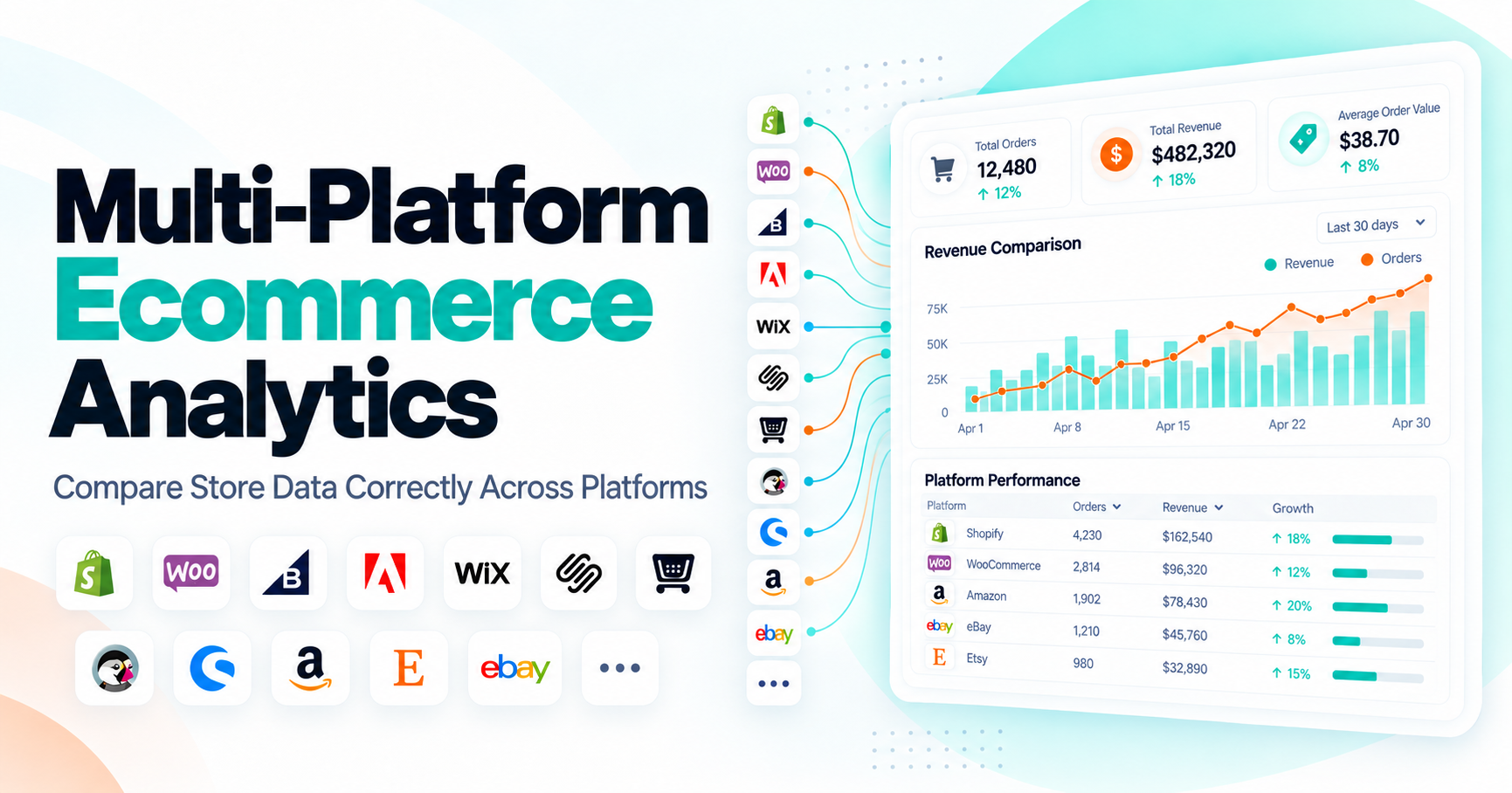
The goal is not to make Shopify, WooCommerce, Amazon, Etsy, eBay and every other commerce system look identical. The goal is to create enough consistency to answer business-level questions while preserving the platform-specific information that would become misleading if it were forced into one definition.
What Is Multi-Platform Ecommerce Analytics?
Multi-platform ecommerce analytics is the process of analyzing performance across more than one ecommerce store, marketplace or commerce system while accounting for differences in how each source defines and records data.
A business might operate a Shopify storefront, sell additional products through Amazon and eBay, and maintain a separate WooCommerce store for another market. Each environment can answer useful questions on its own.
The challenge appears when management asks: How is the whole ecommerce business performing?
Answering that question requires more than putting several dashboards on one screen.
You need to understand which metrics are genuinely comparable, create consistent business definitions where appropriate, and keep platform-specific metrics separate when standardization would distort their meaning.
That is the difference between unified ecommerce analytics and merely collecting numbers from several sources.
Why Do Ecommerce Platforms Show Different Numbers?
They show different numbers because ecommerce platforms have different data models, business rules and reporting purposes. Even two direct-store platforms can calculate familiar metrics differently.
Shopify currently defines net sales as gross sales minus discounts and sales reversals. Its total sales metric adds elements such as additional fees, duties, shipping charges and taxes to net sales.
WooCommerce defines net sales as gross sales minus returns and coupons, while total sales equals gross sales minus returns and coupons, plus taxes and shipping.
Those definitions look similar, but the implementation and timing behind their components are not necessarily identical.
This means a label such as "revenue" should never be combined across platforms before you establish exactly what each source is reporting.
The next October article will go much deeper into why revenue totals differ across platforms. For this article, the important principle is simpler: A shared metric name does not guarantee a shared metric definition.
What Does Metric Normalization Mean?
Metric normalization means translating data from different systems into agreed business definitions so comparable information can be analyzed consistently. It does not mean changing the original source data.
A strong cross-platform analytics system should preserve the native platform values while creating a separate normalized layer for business-level comparison. For example, management might define normalized product revenue as:
Product sales after product discounts and product returns, excluding shipping and taxes.
Shopify data would then need to be mapped to that definition.
WooCommerce data would need to be mapped separately.
Amazon data would require its own transformation based on the fields available.
The normalized result gives management one comparable metric. The original native metrics should still remain available for reconciliation. That distinction is important because normalization should improve comparability, not hide where the numbers came from.
Start With Business Definitions Before Combining Dashboards
The wrong approach to cross platform ecommerce analytics is: Connect every platform first, then decide what the numbers mean.
The better sequence is: Decide what the business needs to measure, define those metrics clearly, then determine how each source maps to those definitions.
If management wants one business-level revenue number, answer questions such as:
Does revenue include shipping?
Does it include taxes?
How are discounts treated?
Are returns applied to the original sale period or the period when the return happened?
Which order states qualify?
Which currency will management use?
Only after those rules exist should platform values be consolidated. Otherwise, a unified dashboard can create a very precise-looking total from inconsistent inputs.
Order Counts Can Also Mean Different Things
"Orders" sounds like one of the easiest metrics to standardize.
It is not.
Shopify separates order status from payment, fulfillment and return statuses. An order can be open, archived or canceled while also having a separate payment status such as pending, paid, refunded or partially refunded.
WooCommerce uses statuses such as pending payment, processing, completed, canceled, failed and refunded. Its analytics settings determine which statuses are included in reports. By default, WooCommerce excludes pending payment, canceled and failed orders, while processing, on hold and completed orders are included.
So if one platform's "orders" includes a transaction state another platform excludes, adding those counts directly can produce an inconsistent business metric. For management reporting, define what an eligible order means.
For example: A customer transaction that reached the business's accepted paid or commercially valid state. The exact technical status that maps to that rule can differ by platform.
Refunds and Returns Need Their Own Normalization Rule
Refunds become especially difficult because their timing can change the period in which performance appears.
Shopify sales reports record sales on the day they occur and sales reversals as negative values on the day the reversal is processed. Shopify also distinguishes sales reversals from physical returns because a monetary adjustment does not always require an item to be physically returned.
WooCommerce's Orders report similarly records refunded orders using separate entries for the original order date and the refund date.
Imagine a $500 order placed on September 29 and refunded on October 3. One management view might want September adjusted because the original sale did not remain successful.
Another might intentionally record the refund in October because that is when the financial reversal occurred. Either approach can be useful.
What creates trouble is allowing different stores to follow different rules inside one consolidated report. Choose a policy and document it.
Average Order Value Is Not Automatically Comparable Either
AOV demonstrates why even familiar ecommerce KPIs need definition checks. WooCommerce calculates AOV as net sales divided by orders. Because WooCommerce net sales subtract returns and coupons, those elements affect its reported AOV.
Shopify's documented AOV calculation uses gross sales minus discounts divided by orders, and post-order adjustments such as later returns are excluded from that calculation.
Two stores can therefore have identical underlying transactions and still produce different native AOV figures depending on the reporting logic. For cross-platform reporting, do not average each platform's reported AOV.
Instead, where the underlying data supports it, calculate a normalized AOV from the combined numerator and combined eligible orders using one agreed definition.
This also avoids another mathematical mistake: averaging averages without weighting them by order volume.
Currency Needs a Consistent Policy
Currency is another place where a unified dashboard can become misleading.
Suppose one store reports in USD, another in GBP and another in EUR.
Adding 50,000 + 40,000 + 30,000 does not produce a meaningful business total.
Choose a reporting currency and a consistent conversion method. Shopify's current reports, for example, allow users to display reporting data in another currency using the historical exchange rate applicable on the transaction date.
For broader multi-platform reporting, the exact exchange-rate source may differ, but the policy should remain consistent. Decide whether historical transactions are converted using the transaction-date rate, period-average rate or another approved financial method.
Then use that method consistently across channels. Do not silently convert one platform using today's exchange rate and another using historical transaction rates.
Time Zones Can Move Sales Between Days
Currency is not the only technical issue. Time zones also matter. An order placed at 11:30 PM in California may already belong to the next calendar day in another reporting timezone.
If several stores use different local time zones, daily comparisons can shift transactions across reporting periods. ShopifyQL, for example, supports explicit timezone handling so time-based results can be calculated against selected timezone boundaries.
For business-level reporting, decide which timezone defines the management day. You can still preserve each store's local reporting separately. The important part is making the consolidated comparison consistent.
Customer Analytics Cannot Always Be Standardized Across Channels
Customer data is particularly sensitive to platform differences.
An owned ecommerce store may have detailed first-party customer records, including purchase history, repeat behavior and customer profiles.
A marketplace may expose a different level of customer information because the marketplace owns more of the relationship.
This affects customer-level metrics such as: new versus returning customers, retention, lifetime value, purchase frequency, customer segmentation, and cross-channel identity.
Do not automatically assume that "customer" means the same identifiable person across every channel. Even when two records have similar names or addresses, identity resolution requires appropriate privacy controls and reliable matching rules.
If customer-level comparability is weak, report the channel's available customer or buyer metrics without pretending you have one perfect cross-platform customer record.
Marketplace Traffic Is Not the Same as Storefront Traffic
Traffic metrics are another area that should not be flattened automatically. Etsy defines visits as unique browsing sessions within a shop and separately reports orders, conversion rate, revenue and listing views.
Amazon Business Reports use metrics such as sessions, ordered product sales, units ordered, order items and ASIN-level sales and traffic information. Amazon defines ordered product sales as item price multiplied by units ordered.
eBay Seller Hub includes sales, selling costs, traffic, listings and seller-performance information. These signals are useful. They are not automatically interchangeable.
An Etsy visit, an Amazon session and an owned-store session should not be forced into one universal traffic metric unless you understand the measurement methodology well enough to justify the comparison.
Sometimes the better approach is to keep them as platform-native acquisition or visibility indicators.
What Can Usually Be Standardized?
Some business concepts are suitable for normalization when the necessary source data is available.
A company can often create consistent definitions for comparable reporting periods, reporting currency, eligible orders, normalized product sales, units sold, product identifiers, refunds and basic product-level performance.
But every normalized metric should answer three questions:
What is the business definition?
How does each platform map into that definition?
What source information is missing or excluded?
If you cannot answer those questions, the metric may look unified without actually being trustworthy.
What Should Stay Platform-Specific?
Some metrics should remain native because they describe the platform's own environment.
Amazon's Featured Offer percentage is meaningful within Amazon.
Etsy listing views are meaningful within Etsy.
eBay seller level and selling-cost metrics are meaningful within eBay.
Shopify storefront sessions and checkout metrics describe Shopify's owned-store environment.
A good multichannel ecommerce analytics system does not erase these distinctions. It can present standardized business metrics at the top level and platform-native diagnostics underneath. Think of it as two analytical layers.
The first layer answers: How is the business performing across channels?
The second answers: What is happening inside this particular platform?
Both are necessary.
Product Matching Creates Another Cross-Platform Problem
The same physical product may not use the same identifier everywhere.
Your Shopify store might use an internal SKU.
Amazon may organize the product around an ASIN.
eBay uses listings and item identifiers.
Etsy has its own listings.
If the same product appears under different identifiers, product performance cannot be consolidated reliably until those records are mapped. This becomes particularly important when management asks: "How many units of Product X did we sell everywhere?"
You need a shared product identity above the platform-specific listing IDs.
SKU mapping is often useful, but even SKUs can be inconsistent if different teams or systems created their own naming conventions. A unified product report is only as reliable as the product mapping underneath it.
Do Not Combine Platform Totals and Call It "One Source of Truth"
A single dashboard becomes valuable only when it creates trustworthy definitions. Your existing guide on one ecommerce dashboard versus multiple apps already explains why centralization does not automatically improve data quality.
This is especially true across ecommerce platforms.
If customer identities are duplicated, currencies are inconsistent, refunds follow different timing logic and order statuses are mapped incorrectly, putting everything in one dashboard does not solve the problem.
It hides the problem behind a cleaner interface. A real source of truth needs a documented measurement layer underneath the visualization.
Preserve Native Data Alongside Normalized Data
One of the safest architectural principles is to keep both. The native metric tells you what the platform reported. The normalized metric tells you how the business chose to interpret comparable information across platforms. For example:
Shopify native total sales should remain available.
WooCommerce native total sales should remain available.
Your company-wide normalized sales metric can then exist separately. This gives analysts and finance teams a reconciliation path when totals do not match. Without the native layer, investigating discrepancies becomes much harder.
Use Cross-Platform Analytics for Questions the Platforms Cannot Answer Alone
The strongest reason to build ecommerce analytics across platforms is not to reproduce the same sales chart in one new place. It is to answer questions that require a business-level view.
Which channel contributed most to overall growth?
Did one marketplace compensate for a decline in the direct store?
Which products perform consistently across multiple channels?
Is inventory being allocated toward the channels creating the strongest demand?
Did overall ecommerce revenue grow because the core store improved or because a new marketplace was added?
Those are cross-platform questions. Your platform dashboards are still valuable for platform-specific investigation. A centralized analytics layer should complement them rather than pretend they are no longer needed.
How Should You Compare Platform Performance Fairly?
Start with comparable business questions instead of identical dashboards. Suppose management wants to compare Shopify and Amazon.
Do not begin by asking: "Can we display the same twenty KPIs for both?"
Ask: "Which outcomes can we fairly compare?"
Sales contribution may be comparable after normalization. Units sold may be comparable after product mapping. Product performance may be comparable at an appropriate level. Website checkout abandonment, however, should not be forced onto Amazon if equivalent data is not available.
Amazon's Featured Offer performance should not be forced into a Shopify storefront metric either. Fair comparison means accepting that some columns will not exist for every platform. Missing comparability is better than false comparability.
Where Statty AI Fits
Statty AI's current direction is broader than a Shopify-only analytics product. It is being developed around ecommerce analytics across stores and marketplaces, with platform-specific commerce data feeding clearer reporting and AI-assisted interpretation.
Current integration availability is not identical across every platform. Shopify, WooCommerce and BigCommerce are currently shown as ready, while Adobe Commerce, Wix, Squarespace, Ecwid, PrestaShop, Shopware, Amazon, Etsy and eBay are shown through upcoming or request-access paths.
You can check the latest connector status on Statty AI Integrations and review the analytics capabilities on Statty AI Features.
One distinction is important here: this article explains how good multi-platform analytics should handle normalization and comparison. It should not be interpreted as a claim that every platform can currently be connected simultaneously and fully normalized inside one Statty AI account unless that capability is explicitly confirmed by the product.
That accuracy matters because true multi-platform analytics depends on connector depth, available fields and consistent metric definitions, not just a long platform list.
Final Thoughts
Multi-platform ecommerce analytics is not about forcing every store and marketplace into the same template. It is about deciding which business questions require consistency and which platform differences need to remain visible.
Revenue needs a shared definition before it is combined.
Orders need clear inclusion rules.
Refunds need a consistent timing policy.
Currencies need one conversion method.
Products need reliable mapping.
Customer metrics need to respect differences in data availability.
Platform-specific signals should remain platform-specific when translating them would remove their meaning. The strongest unified ecommerce analytics model therefore does two things at once.
It standardizes the information that can be compared fairly. And it preserves the differences that matter. That creates a much more reliable answer to the question multi-channel businesses eventually need to ask:
How is the entire ecommerce operation performing, and which store, marketplace or business factor actually explains the change?
FAQ
What is multi-platform ecommerce analytics?
Multi-platform ecommerce analytics is the process of analyzing ecommerce performance across multiple stores, marketplaces or commerce systems while accounting for differences in metric definitions, currencies, orders, refunds, customer information and platform-specific reporting.
Can Shopify and WooCommerce revenue be compared directly?
Not safely without checking the metric definitions first. Shopify and WooCommerce both report concepts such as gross, net and total sales, but their calculation rules and treatment of adjustments can differ. Create an agreed business definition before combining the values.
Why can order counts differ between ecommerce platforms?
Platforms use different order states and analytics inclusion rules. Shopify separates order, payment, fulfillment and return statuses, while WooCommerce uses statuses such as pending, processing, completed, failed and refunded and lets merchants control which statuses are included in analytics.
How should currencies be handled in cross-platform ecommerce analytics?
Choose one reporting currency and one documented conversion method. Historical transaction-date conversion is one approach. Shopify's own reporting can display another currency using historical exchange rates from the transaction date, which illustrates why conversion timing needs to be defined consistently.
Can Amazon, Etsy and eBay use the same metrics as an ecommerce website?
Some commercial outcomes can be compared, but their native analytics should not be treated as identical. Amazon emphasizes metrics such as ordered product sales, units and ASIN performance, Etsy reports visits, orders, conversion and listing activity, while eBay Seller Hub includes sales, selling costs, traffic and seller-performance information.
Should platform-specific metrics be removed from a unified dashboard?
No. A strong unified analytics approach should normalize genuinely comparable business metrics while preserving platform-specific measures when they provide unique context. Amazon marketplace metrics or eBay seller-performance metrics can remain useful even when they have no direct equivalent on an owned storefront.
Does one ecommerce dashboard automatically create one source of truth?
No. A central dashboard only becomes trustworthy when metric definitions, currencies, product mapping, refund rules, date handling and source data are consistent. Centralizing inconsistent data can make reporting look cleaner without making it more accurate.