A growing ecommerce store usually does not need more data. It needs fewer unanswered questions. Revenue is available in the commerce platform. Customer activity lives somewhere else.
Advertising platforms report their own version of performance. Inventory has another set of numbers. Google Analytics shows website behavior. Marketplaces provide separate reports. At first, switching between these systems is manageable. As the business grows, the questions get harder.
- Why did revenue increase without a similar increase in orders?
- Which acquisition channels bring customers who actually come back?
- Are bestselling products likely to run out?
- Which store is really generating the strongest customer value?
- Did the latest campaign create profitable growth or simply more transactions?
This is when dedicated analytics software starts to earn its place. But there is no single best ecommerce analytics software for every growing business. A tool built around marketing attribution solves a different problem from one built around customer lifetime value.
A warehouse-backed analytics platform is very different from an easy store dashboard. The better approach is to match the software to the problem your growth is creating.
Quick Comparison of the Best Ecommerce Analytics Software
| Software | Best For | Main Strength | Important Consideration |
|---|---|---|---|
| Statty AI | Growing stores wanting connected store intelligence and AI explanations | Sales, customers, products, inventory, operational signals and AI-assisted analysis | Best fit when you want broad store performance context rather than only marketing attribution |
| Triple Whale | DTC brands with significant paid marketing | Attribution, channel performance, blended metrics and AI | Advanced capabilities can become more expensive as needs grow |
| Polar Analytics | Scaling DTC teams wanting deeper data infrastructure | Dedicated warehouse, semantic layer, attribution and AI | More sophisticated than many smaller merchants need |
| Lifetimely | Brands focused on LTV, profitability and cohorts | Customer lifetime value, P&L and retention analysis | More specialized than a broad operational store dashboard |
| Glew | Multichannel and multi-store retailers | Broad integrations and unified commerce reporting | Stronger reporting environment can require greater commitment |
| Daasity | Mature omnichannel consumer brands | Deep ecommerce, Amazon, retail, inventory and data infrastructure | Pricing and complexity are better suited to larger operations |
| Google Analytics 4 | Website behavior and purchase-funnel analysis | Traffic, acquisition, ecommerce events and funnels | Does not replace commerce-specific inventory or profitability analytics |
There is deliberate overlap between several of these tools. The important differences appear when you ask what each product was primarily designed to help you understand.
1. Statty AI: Best for Connected Ecommerce Store Intelligence
Best for: Growing ecommerce stores that want sales, customers, products, inventory and operational performance brought into one clearer analytics environment. Many analytics tools begin with one specialist problem.
Statty AI takes a broader store-intelligence approach. The idea is to help merchants connect areas that are often analyzed separately. Revenue can be reviewed alongside orders. Customer behavior can be connected with product performance.
Product demand can be considered alongside inventory. AI can then help surface or explain meaningful changes using the connected business information.
The current Statty AI product includes sales and revenue analytics, customer intelligence, product and inventory insights, checkout and recovery analytics, store-health and SEO information, plus AI insights and chat based on connected store data.
This makes Statty AI particularly relevant when the problem sounds like: “I can see all my numbers, but understanding how they relate takes too much time.” For example, imagine revenue declines.
Instead of treating that as an isolated sales problem, a connected store-intelligence approach can help you investigate whether orders changed, average order value weakened, returning customers became less active, important products lost sales or inventory affected availability.
The goal is not to let AI invent a cause. It is to shorten the route from a visible change to the data that deserves investigation.
Platform Fit
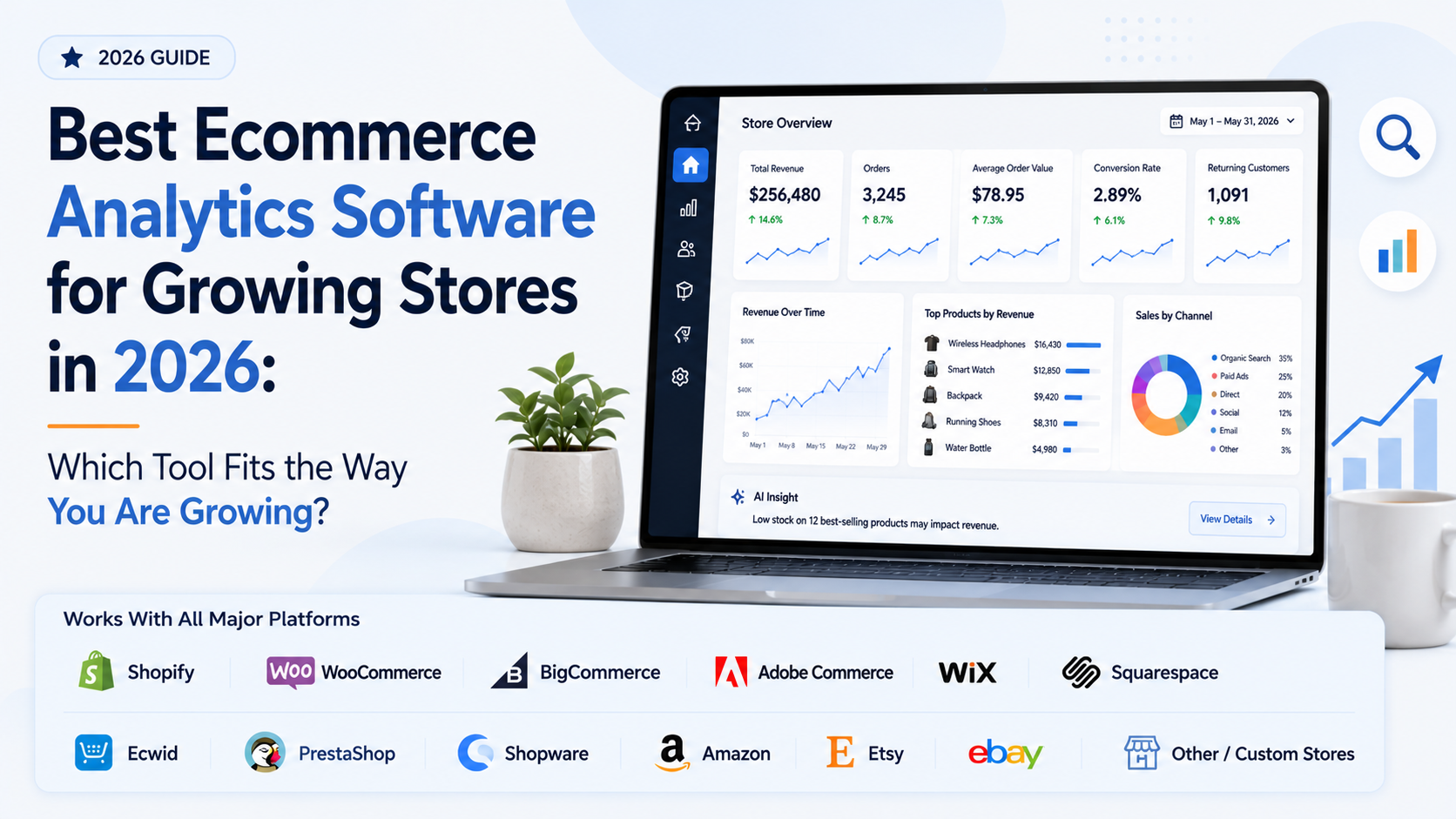
Statty AI is designed for commerce businesses operating through: Shopify, WooCommerce, BigCommerce, Adobe Commerce, Wix, Squarespace, Ecwid, PrestaShop, Shopware, Amazon, Etsy, eBay and other or custom commerce environments. That broader direction matters for growing businesses because many eventually move beyond one storefront or channel.
What Makes Statty AI Different?
Its strongest distinction is not advertising attribution or enterprise data warehousing. It is connected operational ecommerce intelligence. That makes it more appropriate for merchants who want questions such as:
- Which products actually drove this week's change?
- Are our most important products becoming inventory risks?
- Are new or returning customers responsible for growth?
- Where is revenue being lost?
- Which issue deserves attention first?
Statty AI's current public pricing for its Shopify offering starts at $29 per month, with Professional at $49 and Advance at $99, and includes a 3-day trial. Consider Statty AI when: your biggest analytics problem is understanding the whole store rather than optimizing one narrow reporting function.
2. Triple Whale: Best for Paid Marketing and DTC Attribution
Best for: Ecommerce brands where paid acquisition is a major growth engine. If a meaningful share of your revenue depends on Meta, Google, TikTok and other marketing channels, attribution becomes a serious problem as the business scales.
Triple Whale is heavily oriented toward that world. Its current platform combines ecommerce and marketing information, attribution through its Triple Pixel, blended performance reporting and its Moby AI environment.
Triple Whale also says its reporting can combine paid, owned, subscription and organic performance within one view. This makes it attractive when your recurring questions sound like:
- Which advertising channel actually influenced this revenue?
- What is our blended ROAS?
- Which campaigns deserve more budget?
- How are marketing efficiency and business performance changing together?
Triple Whale becomes especially relevant when merchants are no longer satisfied with the attribution reported independently by advertising platforms.
Where Triple Whale Is Strongest
Its strongest use case is marketing-oriented decision making. A growth team running several paid channels may value the ability to connect attribution, campaign performance and store revenue more than detailed inventory operations.
Triple Whale also now layers AI into that environment through Moby, allowing users to interact with the information rather than relying only on fixed reports.
Pricing
Triple Whale currently offers a free tier, while its Foundation plan is listed at $219 per month. Higher-level capabilities and pricing depend on the selected product configuration and requirements.
Consider Triple Whale when: paid media measurement is one of the most expensive unanswered questions in your business.
3. Polar Analytics: Best for Scaling DTC Brands That Want a Stronger Data Foundation
Best for: Mid-market and scaling ecommerce businesses that want ecommerce-friendly reporting but are approaching business-intelligence-level data needs. Polar Analytics sits somewhere between a straightforward ecommerce dashboard and a more sophisticated data platform.
Every current Polar plan includes a dedicated Snowflake database, ecommerce semantic layer, first-party pixel, custom roles and permissions, unlimited users and unlimited historical data.
Its business-intelligence product also includes dashboards, custom reporting, multi-touch attribution, Ask Polar AI, goal tracking, alerts and scheduled reports. This is significantly more infrastructure than many early-stage merchants need. For a growing brand with several teams, however, it can become valuable.
Why the Semantic Layer Matters
Imagine marketing calculates revenue one way while finance uses another definition. Now customer analysis uses a third report. As teams grow, inconsistent definitions become a serious reporting problem. A semantic layer helps standardize metrics so different users can analyze the business from a common foundation.
Polar currently promotes more than 400 prebuilt ecommerce metrics within its AI and data layer, alongside 40+ connectors and dedicated warehouse infrastructure. That makes it attractive to businesses that want advanced analytics without building their entire data stack internally.
Who Is It Probably Too Much For?
If you operate one relatively straightforward store and mainly want to understand sales, customers, products and inventory, a dedicated Snowflake environment may be more infrastructure than your current reporting problem requires. Polar's pricing is currently quote-based rather than presented as a simple public monthly tier.
Consider Polar Analytics when: your store is growing into a data organization, but you do not want to build the complete warehouse and ecommerce analytics layer yourself.
4. Lifetimely: Best for Customer Lifetime Value and Cohort Economics
Best for: Ecommerce brands where repeat purchasing and customer economics drive growth. Some merchants do not mainly struggle with dashboards.
Their biggest unanswered question is: How much is a customer actually worth after the first purchase? That is where Lifetimely becomes much more interesting.
Its current feature set includes LTV and CAC reports, predictive LTV modeling, customer behavior analytics, product journeys, P&L reporting, ad-spend and revenue attribution, cohorts, segmentation and industry benchmarks. That makes it fundamentally different from an all-purpose store dashboard.
Why Cohorts Matter
Imagine two marketing channels each acquire 1,000 customers. Channel A produces stronger first-order revenue. Channel B produces more customers who purchase again over the next twelve months.
If you only judge the channels from the first sale, Channel A wins. If you measure lifetime value, the conclusion may reverse. Lifetimely is built around answering that type of question. It is particularly suitable for:
- Subscription brands.
- Consumable products.
- Beauty and skincare.
- Food and beverage.
- Pet products.
Other businesses where repeat purchasing is central to profitability.
Pricing
Lifetimely currently offers a free plan for businesses processing fewer than 50 orders per month. Its paid pricing begins at $149 per month for up to 3,000 monthly orders, and paid accounts receive a 14-day trial.
Consider Lifetimely when: understanding lifetime value, cohorts and customer profitability matters more than having every operational metric in one system.
5. Glew: Best for Multichannel Commerce Reporting
Best for: Growing retailers whose data is becoming fragmented across stores, marketplaces, marketing systems and operational applications. Glew becomes interesting when ecommerce stops meaning one website.
Its ecommerce analytics product can connect store platforms, advertising, web analytics, fulfillment, loyalty, customer support and other sources. Glew currently advertises integration with Google Analytics and more than 170 applications.
Its prebuilt dashboards cover areas such as:
- Sales.
- Marketing.
- Customers.
- Products.
- Orders.
- Inventory.
- Subscriptions.
It also includes customer segmentation, profitability and LTV reporting.
Why It Works for Multichannel Stores
Suppose you sell through your primary ecommerce site plus Amazon. Looking at each business independently can hide the larger picture. Glew provides dedicated Amazon connectivity and supports combined Shopify and Amazon reporting, including cross-channel
KPI and product analysis. It also has dedicated WooCommerce analytics connectivity. That makes it much more relevant to a merchant whose growth problem is channel fragmentation.
Reporting Depth
Glew Pro provides prebuilt ecommerce dashboards and customer segments, while Glew Plus adds a managed data pipeline, warehouse and Looker-based custom reporting.
That gives the platform a pathway from relatively ready-made reporting toward more sophisticated BI. Pricing for the higher-level offering is customized, and Glew Pro requires annual prepayment according to its current pricing page.
Consider Glew when: you are moving from one-store reporting toward multichannel commerce intelligence.
6. Daasity: Best for Mature Omnichannel Brands
Best for: Larger ecommerce and consumer brands combining DTC, Amazon, retail, marketing, merchandising and operational data. Daasity is the most infrastructure-heavy option in this list.
Its platform is built around centralizing and standardizing ecommerce data rather than simply providing a few additional dashboards.
Daasity currently promotes 60+ ecommerce integrations, automated ELT, customizable transformations, data orchestration, governance, demand forecasting, inventory optimization, merchandising analysis, customer acquisition, retention and segmentation.
It also has substantial Amazon functionality, automatically retrieving Amazon reporting information and allowing it to be blended with DTC and retail channels.
Where Daasity Starts Making Sense
Imagine your company sells through:
- A DTC website.
- Amazon.
- Wholesale.
- Retail locations.
- Subscription channels.
Now marketing, merchandising, finance and operations all need access to related information. That is no longer just a store-dashboard problem. It is becoming a data infrastructure problem. Daasity is designed much more heavily for this level of complexity.
Pricing Tells You Who It Is For
Daasity's current 2026 pricing lists Starter Essentials at $1,499 per month and Essentials at $1,999 per month, with enterprise pricing customized. That immediately tells you this is not intended to replace a $30 analytics app for a small merchant.
Consider Daasity when: your ecommerce analytics challenge has become an omnichannel data-management challenge.
7. Google Analytics 4: Best Free Tool for Website Behavior and Funnel Analysis
Best for: Understanding how people find and move through an ecommerce website. Google Analytics 4 belongs in this comparison even though it does not replace a commerce-intelligence platform. It answers a different set of questions very well.
- How did visitors reach the website?
- Which products did they view?
- Did they add products to cart?
- Where did they stop before purchasing?
- Which acquisition source produced customers?
GA4's ecommerce measurement can analyze product views, purchases and shopping behavior after ecommerce events are implemented.
Its Purchase journey report tracks movement through session start, product view, add to cart, begin checkout and purchase. Its Checkout journey can then examine later checkout stages and reveal where users abandon the process.
Where GA4 Is Not Enough
GA4 is not an inventory-management system. It is not a complete profitability platform. It does not replace detailed operational store reporting. Its ecommerce data also depends on correctly implemented events.
Google explicitly notes that ecommerce events must be sent properly for reports to populate. That means GA4 works particularly well alongside commerce analytics software.
Consider GA4 when: you need traffic, acquisition and behavioral context around the commercial information in your main ecommerce analytics platform.
Do You Need Paid Analytics Software If Your Ecommerce Platform Already Has Analytics?
Sometimes the answer is no. Shopify's current native Analytics environment already provides customizable dashboards, prebuilt commerce reports, custom exploration and real-time monitoring.
In April 2026, Shopify also added daily data-driven insights that analyze sales, sessions and fulfillment information and surface five findings ranked by business impact. Other ecommerce platforms also provide native reporting.
Do not install another analytics product because it appears more advanced. Add software when you can name the gap. For example:
- Native analytics shows what happened, but investigating why takes too long.
- We need advertising attribution across several channels.
- We cannot properly analyze customer lifetime value.
- Our marketplace and storefront data are disconnected.
- Our data volume has outgrown manual reporting.
A specific gap creates a much stronger purchasing decision than simply wanting "better analytics."
Which Ecommerce Analytics Software Is Best for a Small but Fast-Growing Store?
A fast-growing store should normally avoid buying enterprise complexity too early. If the primary need is connected sales, customer, product and inventory intelligence, a focused ecommerce platform such as Statty AI may make more sense than a warehouse-heavy solution.
If paid acquisition is driving much of the growth, Triple Whale may become relevant sooner. If repeat purchases determine the economics of the business, Lifetimely deserves more consideration. The important factor is not simply current revenue. It is which reporting problem is becoming harder as revenue grows.
Which Is Best for a Multi-Platform Ecommerce Business?
Once you sell through several commerce platforms or marketplaces, integration depth and metric normalization matter more. Glew and Daasity are strong examples of products built around multichannel information.
Glew emphasizes unified commerce reporting across 170+ connected applications, while Daasity is designed to standardize information across ecommerce, Amazon and retail environments.
Statty AI also fits this direction when the priority is bringing connected commerce performance into one intelligence environment across Shopify, WooCommerce, BigCommerce, Adobe Commerce, Wix, Squarespace, Ecwid, PrestaShop, Shopware, Amazon, Etsy, eBay and custom stores.
The right choice depends on how much data infrastructure your team wants to manage and how deeply each required source needs to be analyzed.
Which Tool Is Best for Marketing Attribution?
Triple Whale is the clearest specialist on this list when marketing attribution is the main problem. Polar also includes multi-touch attribution as part of its broader business-intelligence platform.
The choice depends on whether attribution is the center of the analytics system or one component of a broader data platform. A merchant spending heavily across multiple paid channels should take attribution much more seriously than a store generating most of its business from direct, organic or repeat customers.
Which Tool Is Best for Customer Retention?
If you want deep cohort economics, predictive LTV and repeat-purchase analysis, Lifetimely is a strong specialized choice. If retention is one part of a broader store-performance question, Statty AI, Glew or another connected analytics environment may make more sense.
This distinction matters. You do not necessarily need the deepest retention tool available. You need enough depth for the decisions your business actually makes.
Should You Use More Than One Analytics Tool?
Sometimes. Trying to force one platform to perform every analytical job can be just as inefficient as maintaining ten overlapping dashboards. A sensible growing-store stack might look like:
- Commerce intelligence: Statty AI, Glew or another central ecommerce platform.
- Website behavior: GA4.
- Advanced attribution: Triple Whale when paid acquisition justifies it.
- Deep LTV analysis: Lifetimely when customer economics require it.
The important rule is that every product should own a different problem.
If three platforms all exist primarily to tell you weekly sales, you probably have unnecessary overlap. For a deeper discussion of that architecture, see One Ecommerce Dashboard vs Multiple Apps.
What Should a Growing Store Actually Spend on Analytics?
There is no useful universal percentage. A $29 analytics product can be expensive if nobody uses it. A $1,500 platform can be economical if it replaces significant manual data work and supports decisions affecting millions in revenue.
Evaluate the cost against the problem. Suppose your team spends eight hours every week combining reports manually. That is more than 400 hours per year. Now an analytics platform that automates much of that work has value beyond the subscription price.
But if your native ecommerce reports already answer everything you need in fifteen minutes per week, expensive third-party software creates little economic value. The best software should reduce one or more of these costs:
- Reporting time.
- Decision uncertainty.
- Data reconciliation.
- Missed operational problems.
- Unnecessary tool overlap.
- Delayed responses to important changes.
Do AI Analytics Tools Actually Help?
They can, but only when AI is connected to reliable business data. There is a large difference between: "Give me ideas to improve ecommerce sales." and: "Which products contributed most to last week's revenue decline?"
The first can be answered generically. The second requires your store's data. AI becomes useful in ecommerce analytics when it helps summarize changes, connect related information or shorten an investigation.
It should not replace the underlying reports. You should still be able to verify the revenue, customer, product or inventory information supporting an AI-generated explanation.
Triple Whale currently uses Moby as its AI layer, Polar offers Ask Polar AI and AI agents, and Statty AI uses AI insights grounded in connected store data.
- The right question is therefore not: Which tool has AI?
- It is: Which tool lets AI work with enough of our real business context to answer useful questions?
Match the Software to Your Growth Problem
If you are still undecided, start from the problem rather than the brand.
- Choose Statty AI when you want connected ecommerce intelligence across core store areas with AI-assisted explanations.
- Choose Triple Whale when paid acquisition and attribution are central to how you grow.
- Choose Polar Analytics when your business needs a sophisticated ecommerce data layer, warehouse infrastructure, custom reporting and attribution.
- Choose Lifetimely when customer lifetime value, profitability and cohorts are your biggest analytical priorities.
- Choose Glew when several stores, marketplaces and connected commerce systems need unified reporting.
- Choose Daasity when you are becoming a serious omnichannel data operation across ecommerce, retail, Amazon and other channels.
- Use GA4 alongside your commerce analytics when website acquisition, browsing behavior and funnel drop-off need deeper investigation.
That is a much more useful definition of "best" than ranking every product from one to seven.
Where Statty AI Fits for Growing Stores
Statty AI is most relevant to the gap that appears between basic ecommerce reporting and a much heavier business-intelligence implementation. A growing merchant may not need to build a data warehouse.
They may simply need sales, customers, products, inventory and other store information to make more sense together. Statty AI is designed to provide that connected view and make important changes easier to investigate through visual analytics and AI-assisted explanations.
Businesses operating through Shopify, WooCommerce, BigCommerce, Adobe Commerce, Wix, Squarespace, Ecwid, PrestaShop, Shopware, Amazon, Etsy, eBay and other or custom ecommerce stores can use this type of connected intelligence approach as reporting becomes more complex.
You can explore the Statty AI analytics features or visit Statty AI to compare its approach with the more specialized platforms discussed above. For a deeper buyer framework before committing to any analytics platform, read How to Choose Ecommerce Data Analytics Software.
Final Thoughts
The best ecommerce analytics software for growing stores is not necessarily the product with the biggest feature list. It is the product that removes the biggest analytical bottleneck your growth has created.
For one business, that is understanding advertising attribution. For another, it is customer lifetime value. Another needs inventory and product performance connected with sales. A multichannel retailer may simply need one trustworthy view across several selling environments.
As your store grows, choose software based on the questions becoming harder to answer. Start with the reporting problem. Identify the type of analysis required. Then choose the platform that solves that problem without introducing far more complexity than the business needs.
The goal is not to build the most impressive analytics stack. It is to reach the point where an important change happens in your store and your team can quickly answer: What changed, where did it happen, why does it matter, and what should we investigate next?