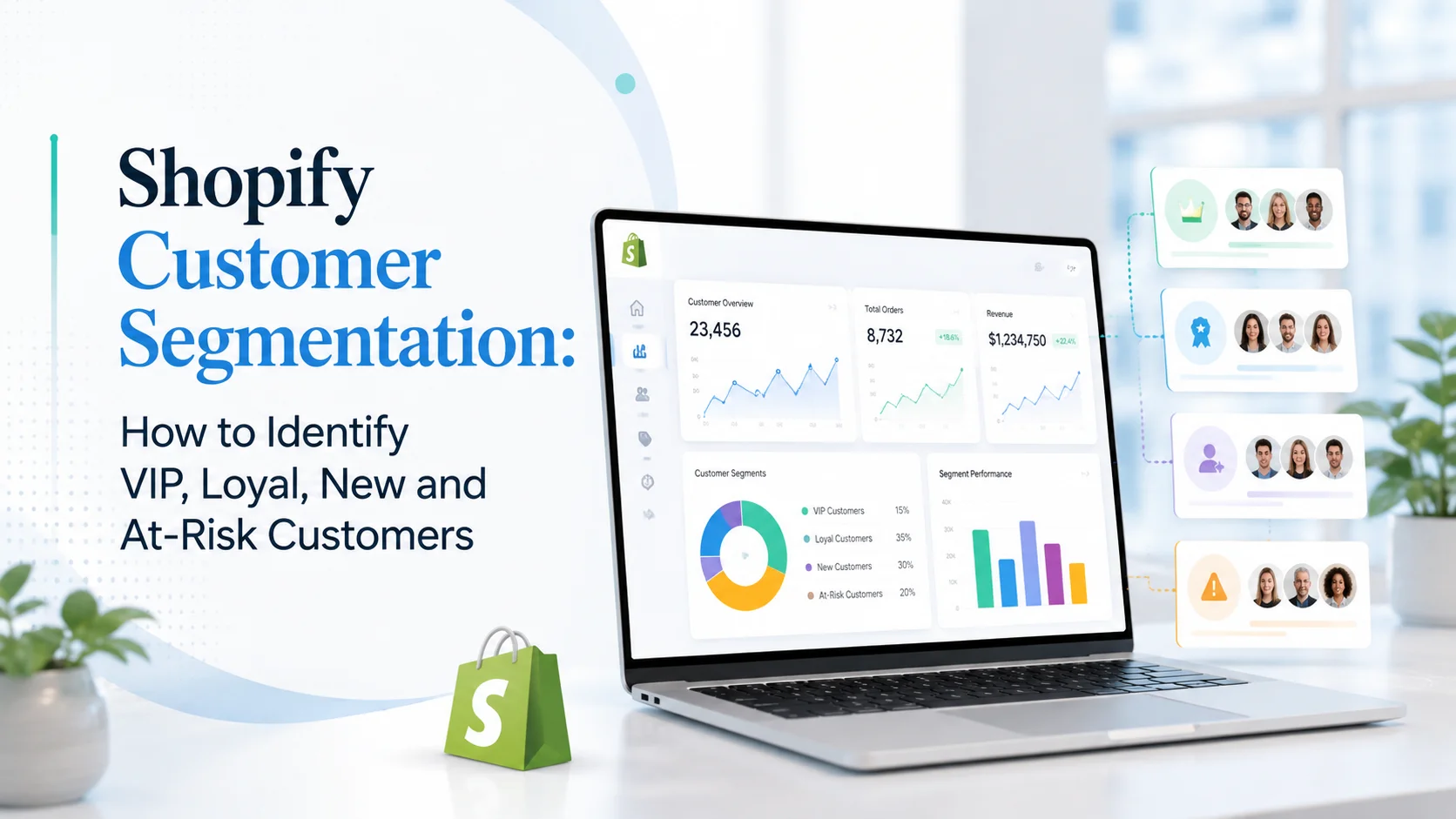
Segmentation groups customers according to shared behavior or characteristics so you can understand them more clearly and communicate with them more appropriately. Instead of looking at one large customer list, you can identify groups such as new customers, loyal buyers, high-value customers and people who may be at risk of becoming inactive.
Shopify currently supports dynamic customer segments built with rules using filters such as amount spent, number of orders, last-order date, products purchased, predicted spend tier and RFM group. Customers are automatically added to or removed from a segment when they begin or stop meeting the rules.
The important part is not creating dozens of segments. It is understanding what each group means and what decision it should help you make.
Customer Segments Should Reflect Behavior, Not Just Labels
Terms such as VIP, loyal, new and at risk sound straightforward, but they should not be treated as universal definitions. A VIP customer for a store selling $20 accessories will look very different from a VIP customer for a store selling $2,000 furniture.
Likewise, a customer who has not purchased for 60 days may be concerning for a coffee subscription business but completely normal for a store selling products customers replace once per year. Good segmentation therefore combines platform data with your own business context.
The label is useful only when the rule behind it makes sense. For a broader view of customer behavior, retention and customer value, see our Shopify customer analytics guide.
New Customers: Focus on What Happens After the First Order
A new customer has only just entered the relationship with your store. The first purchase is important, but the more useful question is: What should happen next?
A new-customer segment can help you separate people who have recently placed their first order from established buyers. The goal at this stage is usually not to push another promotion immediately. It is to create confidence in the purchase and make the second order more likely when the timing is appropriate.
That could involve better onboarding, product-use guidance, delivery communication, complementary product recommendations or simply a strong post-purchase experience. Shopify's RFM analysis includes a New group for customers with very recent purchases but relatively few orders and low historical spend.
Shopify recommends moving these customers toward more active engagement by building the relationship after purchase. The important metric is not simply how many new customers you acquired. It is how many eventually move beyond being new.
Loyal Customers: Look for Consistency, Not One Large Order
Loyal customers are customers who have demonstrated an ongoing relationship with the store. They are usually more useful to identify through a combination of recency, repeat purchase behavior and spending rather than simply ranking customers by lifetime revenue.
A customer who made one very large order may be valuable, but that does not automatically make them loyal. Another customer may spend less per order but purchase consistently throughout the year. That customer has demonstrated a different type of value.
Shopify's current RFM model defines Loyal customers as people with relatively recent purchases, many orders and high spending compared with other customers in the same store. This makes loyal customers useful for questions such as:
Which customers repeatedly choose us?
Which products are popular among our strongest repeat buyers?
Are loyal customers becoming more or less active?
Which loyal customers may be ready to become brand advocates?
These customers may be appropriate for early product access, loyalty benefits, relevant upsells, review requests or referral programs. The goal should be to strengthen an existing relationship, not simply send more discounts because the customer has already spent money.
VIP Customers: Define Them Around Your Business
VIP is one of the most commonly used ecommerce segment labels, but Shopify's current RFM groups do not include a group literally named “VIP.” Shopify's native RFM labels include groups such as Champions, Loyal, Active, New, At risk and Previously loyal.
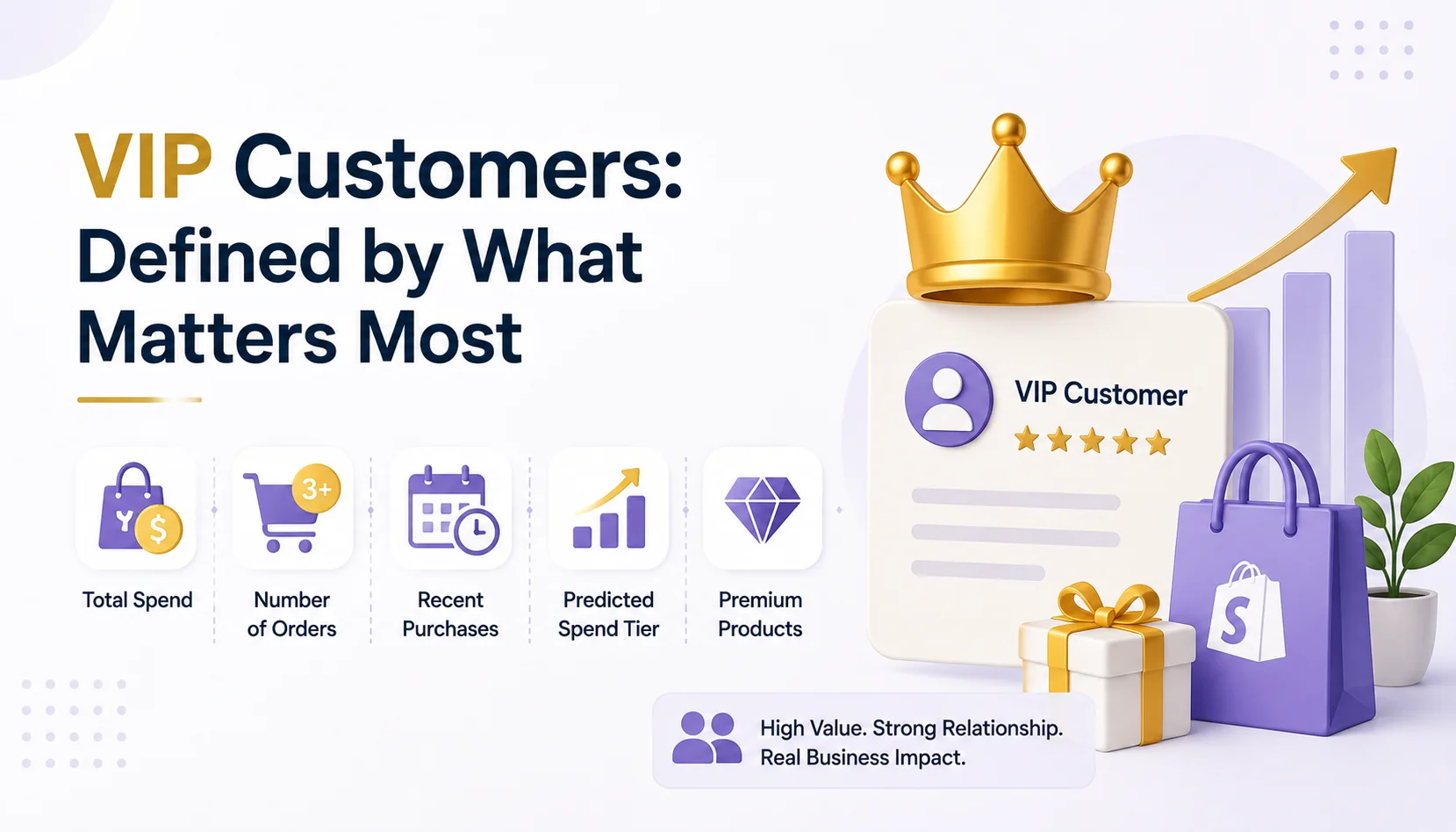
That means a VIP segment is something you should define according to your own business rules. You might build a VIP segment around:
Total amount spent
Number of orders
Recent purchase activity
High predicted spend tier
Purchase of specific premium products
A combination of spend and frequency
Shopify's segmentation system supports filters for amount spent, order count and individual order behavior. It can also identify customers in High, Medium or Low predicted spend tiers for qualifying stores.
A useful VIP definition might be: Customers who spent more than a meaningful threshold, placed several orders and purchased recently. That is stronger than using lifetime spend alone.
For example, a customer who spent $2,000 three years ago and never returned may not deserve the same treatment as someone who spent $1,500 across six recent purchases. VIP status should reflect current business value, not just historical value.
Champions Can Be a Useful Starting Point for VIP Identification
If you do not yet have a formal VIP definition, Shopify's Champions RFM group can provide a useful starting point. Shopify describes Champions as customers who purchased very recently, have many orders and rank among the highest spenders. The recommended goal is to retain them as advocates through approaches such as early access, exclusive offers or referral activity.
You do not need to rename every Champion a VIP. Instead, use this group as evidence. Look at what your Champions have in common.
Which products do they buy?
How often do they purchase?
How much do they typically spend?
How long did it take them to move from a first order to repeat purchases?
Those patterns can help you create a VIP definition that actually reflects your strongest customers.
At-Risk Customers: Focus on Lost Momentum
An at-risk customer is not simply someone who has not purchased recently. The most important part is that they used to be valuable or active. Shopify's RFM system describes At risk customers as people without recent purchases but with a strong previous history of orders and spending.
This makes the segment much more meaningful than a generic “inactive customers” list. Imagine two customers have not ordered in six months.
Customer A made one small order.
Customer B previously purchased every month and spent significantly more than average.
Customer B represents a much more important relationship to investigate.
Your at-risk segment should therefore consider both: How long it has been since the last order and How valuable or active the customer was before that gap This helps you prioritize win-back activity instead of treating every inactive customer as equally important.
Previously Loyal Customers Need Different Treatment From At Risk Buyers
Shopify also distinguishes Previously loyal customers from the general At risk group. Previously loyal customers have not purchased recently but have a particularly strong history of orders and spending. That distinction can be valuable.
A customer who once belonged among your best buyers but has disappeared may deserve a more personalized investigation. Perhaps a favorite product was discontinued. Maybe their purchase cycle changed. Maybe service quality declined.
Or perhaps they simply no longer need the product. The data does not automatically tell you the reason. But segmentation tells you that this is a customer relationship worth examining more carefully.
Do Not Force Customers Into Only One Segment
Real customer behavior is messy. A customer can be:
A loyal buyer
A high spender
An email subscriber
A buyer of one specific product category
Located in a particular region
all at the same time. Shopify allows a customer to belong to multiple segments when they meet the rules for each one. This is useful because segmentation should answer different business questions.
You might have one segment for VIP treatment, another for customers interested in a particular product family and another for customers who have not purchased recently. Do not try to create one perfect label that describes the entire customer. Use segments as lenses. Each lens should help answer a specific question.
Use Purchase Timing to Make Segments More Realistic
Recency should be interpreted according to the natural purchase cycle of the product. Suppose you sell skincare products that customers usually repurchase every six weeks. A previously loyal customer who has not ordered for four months may genuinely be at risk.
Now imagine you sell mattresses. A customer not repurchasing after four months is completely normal. This is why a generic rule such as: No purchase in 90 days = at risk can be misleading.
Build recency rules around how customers actually buy from your store. You can learn this by looking at repeat-purchase timing, product type and historical behavior. Segmentation becomes much more useful when it reflects the rhythm of the business.
Product-Based Segments Can Reveal Why Customers Behave Differently
Customer value is often connected to what the customer buys. Shopify's segmentation filters can include products purchased, which makes it possible to build customer groups around specific product behavior. This can answer useful questions.
Do customers who begin with Product A become loyal more often than customers who start with Product B?
Which products are commonly purchased by VIP customers?
Are at-risk customers concentrated around a particular product category?
Do loyal customers purchase certain combinations more often?
These insights can influence merchandising, cross-selling and retention strategies. Instead of viewing products and customers as separate parts of the store, you begin to understand how product choices shape customer relationships.
Predicted Spend Tier Can Add Another Layer
Stores with more than 100 sales can use Shopify's predicted spend tier, which categorizes eligible purchasers into High, Medium and Low expected future spending groups.
Shopify says the prediction considers factors including purchase frequency, average order spending, order count and recency. This can be useful when building customer segments. For example, you might combine:
High predicted spend + marketing subscriber
Loyal customer + High predicted spend
Recent buyer + High predicted spend
These combinations can help prioritize customers who may deserve additional attention. However, predicted value is still a forecast. It should support a decision, not replace actual customer behavior.
Create Segments Around Actions
A segment becomes valuable when you know what you intend to do with it. Do not create a group named “VIP Customers” simply because it sounds useful. Ask: What will we do differently for this group? A practical segment strategy might look like this:
New customers: Improve onboarding and encourage the next relevant purchase.
Loyal customers: Strengthen the relationship with recognition, recommendations and loyalty benefits.
VIP customers: Provide higher-touch experiences, exclusive access or premium support where appropriate.
At-risk customers: Identify why engagement weakened and test targeted reactivation.
Previously loyal customers: Treat them as high-priority win-back opportunities where the economics make sense.
Champions: Encourage advocacy, reviews and referrals while protecting the relationship.
The messaging, timing and offer should fit the group. Segmentation is not simply a reporting exercise. It is a way to avoid giving every customer the same experience.
Measure Movement Between Segments
One of the most useful ways to judge a segmentation strategy is to watch how customers move over time. You want to know whether:
New customers become Active.
Active customers become Loyal.
Loyal customers become Champions.
At-risk customers return.
Previously loyal customers re-engage.
At the same time, you want to notice when valuable customers begin moving in the opposite direction. This gives you a better measure of customer health than simply reporting the number of people currently inside each segment. A strong customer strategy should create positive movement through the lifecycle rather than simply maintaining static lists.
Be Careful With Discounts
Segmentation makes targeted discounts easy. That does not mean every segment should receive one. A loyal customer might value early product access more than 10% off. A VIP customer may value priority support.
An at-risk customer may respond to a useful reminder if their normal repurchase window has passed. A new customer may need education rather than another sale immediately after buying.
Discounts can be valuable when there is a clear reason to use them, but repeatedly rewarding customers only with price reductions can train them to wait for offers. Use the customer behavior behind the segment to decide what type of communication makes sense.
A Practical Segmentation Example
Imagine your Shopify store has 8,000 customers. Instead of sending the same campaign to all 8,000, you divide the database into meaningful groups. You find that 400 customers purchase frequently and have high recent spending. Another 1,100 recently placed their first order.
Around 250 customers previously purchased often but have not returned within their usual purchase cycle. These groups require different strategies. The first group may receive early access to a new product. The second may receive product education and onboarding.
The third may receive a personalized win-back message based on what they previously purchased. The total customer count did not change. What changed was your understanding of who those customers are. That is the practical value of segmentation.
Use Shopify's Dynamic Segments Instead of Static Lists Where Possible
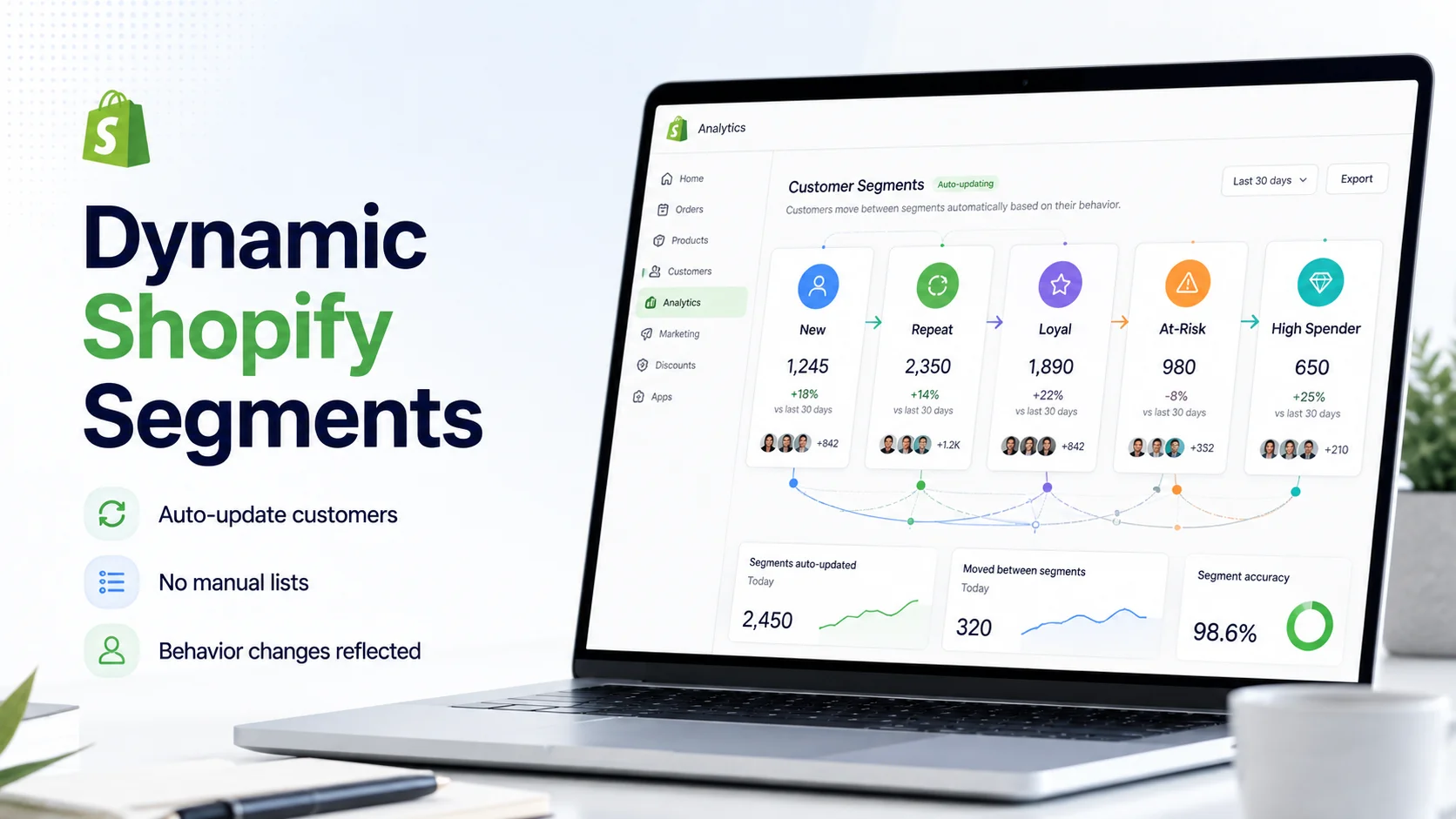
One useful feature of Shopify customer segmentation is that segments are dynamic. When customers begin meeting a segment's criteria, Shopify adds them automatically. When they stop meeting those rules, Shopify removes them. This matters because customer relationships are constantly changing.
A new customer becomes a repeat customer.
A loyal customer becomes inactive.
An at-risk customer comes back.
A high spender drops below the conditions you defined for a particular campaign.
Dynamic segmentation reduces the need to rebuild customer lists manually every time behavior changes.
Where Statty AI Fits
Shopify already provides powerful native customer segmentation and RFM tools. A broader analytics platform becomes useful when you want those customer groups connected with the rest of store performance.
For example, you might want to know whether declining loyal-customer activity is happening alongside a product stock issue or whether VIP customers contribute a growing share of store revenue.
Statty AI's Shopify analytics dashboard combines customer intelligence with sales, products, inventory, checkout activity and other performance data. For the wider customer-analysis picture, read our Shopify customer analytics guide, or explore Statty AI as an AI-powered Shopify analytics app.
Better Segmentation Starts With Better Definitions
The biggest mistake in customer segmentation is using labels without understanding the rule behind them.
Do not call someone VIP simply because they made one large purchase.
Do not call someone loyal simply because they bought twice.
Do not call every inactive customer at risk.
And do not treat new customers as though they already have an established relationship with your brand. Instead, define segments using behavior that matters to your business. Look at recency, frequency, spending, product history and the customer's natural purchase cycle. Then connect each segment to a specific action.
That is when Shopify customer segmentation becomes more than organizing a customer list. It becomes a practical way to understand where each customer relationship stands and what deserves attention next.